
Lab-quality diagnostics. Right at your fingertip
With Our Proprietary Single-Molecule Immunoassay for the Point of Care
Learn MoreTowards Decentralized Diagnostics
The paradigm shift from centralized lab testing to home and Point-of-Care (POC) testing was long anticipated. Yet many POC solutions face the fundermantal constrains: high test cost, limited reliability, and insufficient analytical sensitivity. As a result, accurate diagnostics are still largely confined to centralized labs, creating delays, accessibility barriers, and significant healthcare system burden.
NanoSense is addressing these challenges by developing a single-molecule immunodiagnostic platform that delivers lab-grade sensitivity at the point of care. By overcoming the traditional trade-offs between cost , accuracy , and accessibility , NanoSense enables patients to assess critical health conditions directly—whether at home or in neighborhood clinics—without prolonged waiting times, complex workflows, or prohibitive costs.
Single Molecule Mechanical Selection (SMMS)

Sensitivity
An unambiguous signal can be generated by the capturing of a single target biomolecule, making our assay the genuine single molecule detection. Ultra sensitivity is the foundation for us to develop early screening for many diseases using blood samples.
Specificity
A first-of-its-kind mechanical force is employed to selectively eliminate nonspecific, weaker bindings, while specific, stronger bindings are retained. This invention safeguards the detection specificity in complicated biosamples.
Simplicity
Mix, load, flip and detect. For as simple as 4 steps and as fast as 30 minutes, ultra-sensitive, quantitative results are out.
SMMS vs Other Immunodiagnostic Technologies for Blood Biomarker Detection
Key Lab Verification Results
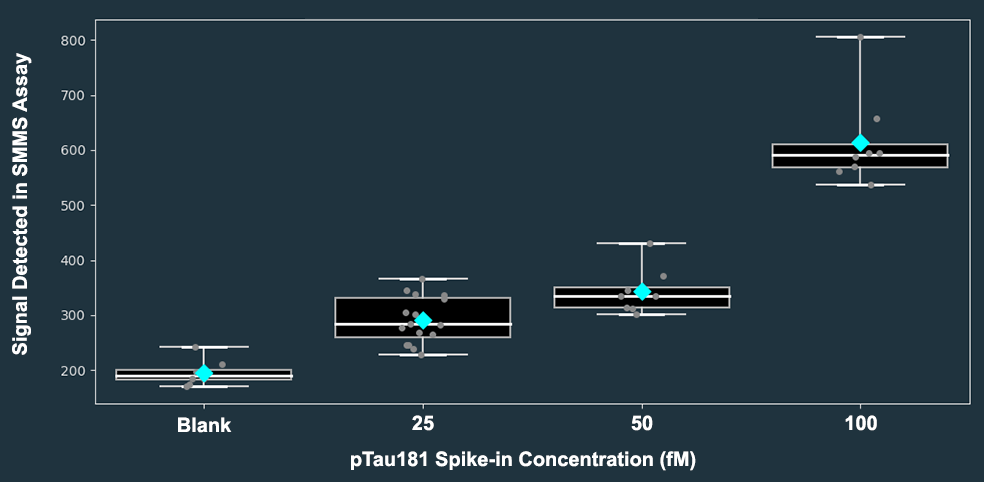
Initial testing revealed an 87.5% detection rate when using the SMMS assay on plasma samples spiked with 25 fM of pTau181. This result indicates that our assay's current Limit of Detection (LoD) is approximately 25 fM. We are actively working to improve the sensitivity further.
Publications
Clinical Validation Results
To be revealed in the near future
Collaborators